Happy Friday Friends!
It has been another fantastic (but VERY busy) week here at ELM. We are well into our Winter programs and I am already preparing for our Spring Session...starting early with our Womens 10K Clinic that kicks off February 19th. I am working on lot's of fun projects including the rebranding of the ELM logo and putting the final touches on our womens retreats for 09. Check your inbox this weekend for our February e-newsletter (or email us to sign up for it) as there will be plenty of cool news this month.
Last week I wrapped up my training with a great Saturday morning trail run with my fearless leaders Kathy, Lynn and Lisa at Seal Bay Park. We ran 1:45ish in the trails and then went for cinnamon buns and lattes at Beckys Bakery...yum! Sunday I hid inside once again on the bike trainer and rode to nowhere for 2 hours Z1! How does one mentally get through that you might ask? I used a variety of techniques: distraction being the most effective- watched cooking shows...read books (100 useful marketing tips)...and called my sister which killed the last 30 minutes yeah! At one point I had to take the tough love approach: I had to smack myself into reality and remind myself that I will need to be able to keep my legs spinning for up to 4-5 plus hours during adventure races this summer so I had better be able to keep on ridin' for 2 measly ones. A banana, fruit bar and litres of h20 kept me energized during the session...and it wasn't so bad! This week I vow to get back on the dirt!
This week is recovery week- YEAH and my legs are in need of it.
- Monday- I did an easy spin instead of my planned run to take another day off impact.
- Tuesday - the usual Bootcamp and SCORE!
- Wednesdsay- run 35 and ride 25 with Adventure Mix
- Thursday- Bootcamp and Race Pace Intervals Z3 with Need for Speed at the track.
- Friday- 60 minute Z1
- Saturday- REST and First Aid recert with St Johns ALL DAY...and it had better rain all day.
- Sunday- Ride XC 2+hours
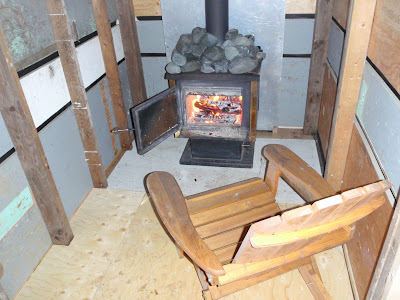
This week I also got to enjoy the relaxation benefits of HEAT...oh sweet HEAT...as Brad put the finishing touches on our backyard sauna!! I have never been a sauna person but I am changing teams now! I can't tell you how fantastic it is to sit in the sauna and chug cold water for 45 minutes before rinsing off and rolling into bed- talk about sinking into a deep sleep!
This pic does not show the finished project as it has all been insulated now...but it gives you the idea. Combine one big woodstove with a 5*10 wood shed/bomb shelter and voila...heat you can't even imagine!
OK on to Friday Q&A:
OVERLOAD PRINCIPLE
Q: HI SARAH, MY QUESTION IS : WHAT SHOULD I DO AFTER I FINISH THE NOVICE LEARN TO RUN CLINIC? BY THE END I WILL BE RUNNING A FULL 30 MINUTES. DO I INCREASE IN INCREMENTS OF 5 MINUTES EVERY WEEK OR TWO, OR JUST A LITTLE EACH TIME I GO OUT? I PLAN ON DOING A 10K IN APRIL.THANKS, REGARDS JOANNE
A: Great question Joanne! First of all, congratulations on completing the Learn to Run program! After 10 weeks of progressive run:walking you now have a great base to build your running career upon! I often receive questions about progressing beyond a beginner or novice running program and there are some guidelines to follow when doing so.
Becoming a runner takes patience. New Years Resolutions tend to be loaded with intensity and firecracker power, but learning to harness that energy is the key to success. Following a progressive run:walk program is the safest and most effective way to incorporate running into your life and ensure you stick with it over the long term. I have heard way too many tales of new (and very enthusiastic!) runners who go hard and then go home injured and defeated.
Passion is only one part of the running equation and you must introduce any new activity slowly and consistently to reach your fitness goals. The body responds to gradual increases in activity (frequency, intensity and time) – which in exercise phys. circles is known as the “Overload Principle”. Yes, another one of my 'rules to live by' when training.
In order to improve our fitness (including all aspects- strength, speed, power, flexibility, stamina, balance etc) we must provide our body with MORE then it is already used to. That is, we must OVERLOAD the systems (muscular, cardiovascular etc) which causes the body to rebuild stronger in an effort to adapt to the new workload. But how much overload do we need? This is the delicate balance we call training.
Too much overload (or too much too soon) will break down the body beyond it's ability to cope resulting in fatigue or worse- INJURY.
Too little overload, however, will not get us to our goal on time.
The answer is in small, progressively higher doses on a weekly basis. Every body has different needs, of course, but there is a safe rule that you can follow when planning your own running program: The 10% rule. Simply put, you increase your weekly volume (total training time) by no more than 10% each week.
Looking at your specific question regarding running endurance- you would need to build upon your current 30 minute endurance. Let's say you are running 30 minutes (5Kat a 6min km pace) 3 days per week and you want to build up to running endurance to 60 minutes (10K). I would pick 1-2 runs per week to build your endurance up to 45 minutes and then continue to build 1 of these runs up to 60 minutes in order to prepare specifically for the race. Start by adding 5 minutes to your long run each week. This is a very safe increase and your body should respond well to the overload.
Depending on your specific goals for the 10K race you may also include race pace repeats, over-distance training & hill training leading up to the event. I could write an entire article on 10k training, however!
*A word on recovery: No program is complete without scheduled recovery weeks and rest days. Every few weeks you will need to decrease your training volume slightly (by 25-50%) to give your body a chance to play catch up: rebuild, re-synthesize, and re-generate tissues and systems. Depending on your training program you should plan in a recovery week every 3-6 weeks and you will come back stronger and healthier to your training.
Happy Training!
Sarah.
 TUESDAY:


 Here I come! Up Up Up...the sunshine made it much easier:)
 Then it was onto the bikes for our second trip up and over the Hill...
 From the summit it is all downhill once again! Yeehaw!


 Climbing on the new rig...
 Showing me how the aerobars work...
 Look at that! What a pro! I wish I had a BUSH PILOT sponsorship! Or was it a rockhopper?


 Still smiling!
 Here is one of the trial bikes...Specialized...
 This was the most disgusting bar I have ever eaten. I just had to tell you that. I had a bite of Pascales bar cause it smelled so chocolatey and yummy...but yick! Sorry Detour but it was a no go for me.